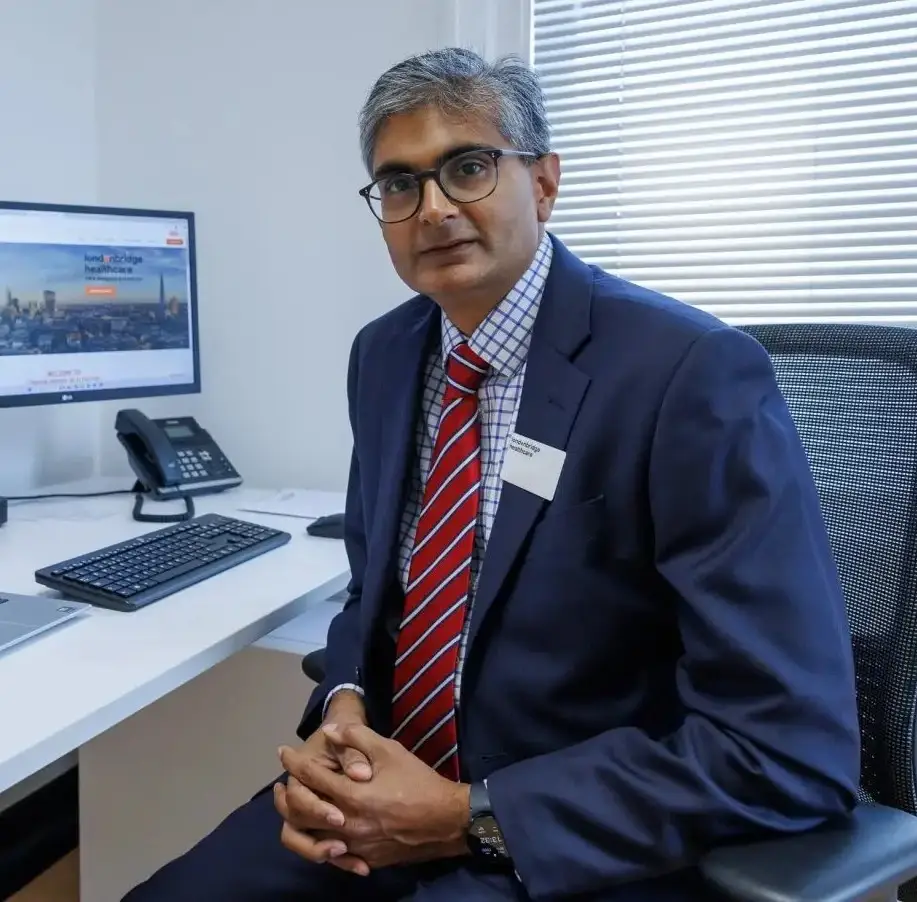
Mr Sandip Sarkar

Vascular VEINS specialist

FRCS; MA (Cantab); PhD 

Vascular Surgeon

Sandip Sarkar qualified in preclinical medicine from St Catharine’s College, Cambridge and undertook clinical medical training at the United Medical and Dental Schools of Guys and St Thomas Hospitals in London. He trained in General and Vascular Surgery in the London Deanery and was awarded his PhD in Vascular Surgery at University College London. He works as a Consultant Vascular Surgeon at the Royal London Hospital and is Clinical Lead for the Department of Vascular Surgery at Barts Health NHS Trust as well as the vascular Lower Limb Lead for northeast/east London.

He has a wide-ranging clinical experience of various modalities of endovenous therapy for venous insufficiency including Radiofrequency Ablation (RFA); Endovenous Laser Therapy (EVLT); Cyanoacrylate Glue and Fibrovein Foam Sclerotherapy, he set up, developed and delivered one of the largest local anaesthetic varicose veins services in the National Health Service.

His other clinical interests include diabetic foot revascularisation and wound care. He developed RAPIDgel, the first autologous medicine authorised for use at the point of manufacture by the Medicines and Healthcare Regulatory Authority (MHRA). In the NHS he has set up and runs a number of other programmes including a high risk podiatry service; a vascular surgical ambulatory care service; a Diabetic Foot MDT networked across primary and secondary care.

His active research involves diabetic vascular disease and population health data, and he heads a Barts Life Sciences Artificial Intelligence (AI) programme on predictive modelling for diabetic foot disease progression. He is the National Institute for Healhcare Research (NIHR) North Thames Clinical Research Network Specialty Lead for Vascular Surgery and supports Start Ups and SMEs that are developing digital technologies to improve care for patients with diabetes and vascular disease.

Mr Sandip Sarkar, Consultant Vascular Surgeon at London Bridge Healthcare
Vascular and vein specialist

Mr Sandip Sarkar

Consultant Vascular Surgeon
FRCS · MA (Cantab) · PhD

Consultant vascular assessment for varicose veins and venous insufficiency at London Bridge Healthcare. Mr Sarkar brings extensive experience in minimally invasive vein treatments and lower limb vascular care.

Speciality Vascular Surgery,
RFA, EVLA,
Foam Sclerotherapy
FocusVaricose veins and endovenous care
LocationLondon Bridge, SE1
About Mr Sarkar

Consultant Vascular Surgeon with Extensive Clinical Experience

Sandip Sarkar qualified in preclinical medicine at St Catharine’s College, Cambridge, before undertaking his clinical medical training at the United Medical and Dental Schools of Guy’s and St Thomas’ Hospitals in London. He trained in General and Vascular Surgery within the London Deanery and was awarded his PhD in Vascular Surgery at University College London (UCL).

He is a Consultant Vascular Surgeon at the Royal London Hospital and has held significant clinical leadership roles, including Clinical Lead for the Department of Vascular Surgery at Barts Health NHS Trust and vascular Lower Limb Lead for north-east and east London.

He has extensive clinical experience in endovenous treatments for venous insufficiency, including radiofrequency ablation (RFA), endovenous laser therapy (EVLA), cyanoacrylate glue treatment and Fibrovein foam sclerotherapy. He established, developed and delivered one of the NHS’s largest varicose vein treatment services performed under local anaesthetic.

His other specialist interests include diabetic foot revascularisation and vascular wound care. He developed RAPIDgel, described as the first autologous medicine authorised for use at the point of manufacture by the Medicines and Healthcare products Regulatory Agency (MHRA). Within the NHS, he has established and leads several specialist programmes, including a high-risk podiatry service, a vascular surgical ambulatory care service and a multidisciplinary diabetic foot network spanning primary and secondary care.

His active research focuses on diabetic vascular disease and population health data. He leads a Barts Life Sciences Artificial Intelligence (AI) programme focused on predictive modelling of diabetic foot disease progression. He is also the National Institute for Health and Care Research (NIHR) North Thames Clinical Research Network Specialty Lead for Vascular Surgery and supports start-ups and small and medium-sized enterprises (SMEs) developing digital technologies to improve care for patients with diabetes and vascular disease.

Conditions and concerns

Varicose Vein Symptoms and Concerns

At London Bridge Healthcare, Mr Sarkar provides consultant vascular assessment for varicose veins and venous insufficiency. A clinical assessment and duplex ultrasound can help determine whether treatment is appropriate.

01

Visible Varicose Veins

Enlarged, twisted or prominent veins in the legs.

02

Aching or Heavy Legs

Aching, heaviness or discomfort, particularly after standing.

03

Leg or Ankle Swelling

Swelling that may be associated with venous problems.

04

Venous Insufficiency

Assessment of venous reflux and how efficiently blood returns from the legs.

05

Skin Changes or Itching

Itching or skin changes that may need vascular assessment.

06

Vein Treatment Advice

Advice on appropriate investigations and available treatment options following consultation.

Clinical Expertise

Varicose Vein Assessment and Treatment Options

London Bridge Healthcare offers consultant-led vascular assessments and duplex ultrasound to guide suitable treatment options for varicose veins. Mr Sarkar has experience in a range of endovenous procedures; recommendations depend on the consultation and scan findings.

Treatments described by the clinic

  • Radiofrequency ablation (RFA)
  • Endovenous laser ablation (EVLA)
  • Foam sclerotherapy
  • Phlebectomies / avulsions

Additional Professional Experience

  • Cyanoacrylate glue treatment for selected venous disease
  • Diabetic foot revascularisation
  • Vascular wound care and multidisciplinary lower limb services
Training and Leadership

Professional Qualifications and Clinical Background

01

University of Cambridge

Preclinical medical education at St Catharine's College, Cambridge.

02

Guy' s and St Thomas' Hospitals

Clinical medical training at the United Medical and Dental Schools of Guy' s and St Thomas' Hospitals, London.

03

London Deanery and University College London

Specialist training in General and Vascular Surgery within the London Deanery, followed by a PhD in Vascular Surgery at UCL.

04

Royal London Hospital and Barts Health NHS Trust

Consultant Vascular Surgeon with extensive experience in vascular clinical leadership and NHS service development.

05

Regional Lower Limb Vascular Care

Experience in leadership of vascular lower limb services across north-east and east London.

06

NHS Service Innovation

Development of services including high-risk podiatry, vascular ambulatory care and multidisciplinary diabetic foot pathways connecting primary and secondary care.

Academic and Clinical Research

Research Experience

Alongside his clinical work, Mr Sarkar has contributed to vascular surgery and wound care research, including vascular graft development, tissue engineering and diabetic foot disease. His research interests also include the use of health data and predictive modelling to better understand the progression of diabetic foot disease.

He has held the NIHR North Thames Clinical Research Network Specialty Lead role for Vascular Surgery and has been involved in the Barts Life Sciences AI programme exploring predictive modelling in diabetic foot care.

Selected Research Publications

Published Research in Vascular Surgery and Wound Care

Mr Sarkar has contributed to published research covering vascular graft development, tissue engineering, cardiovascular imaging, wound healing and vascular disease.

  1. Hwang R, Crook D, Allan CS, Sarkar S. A network meta-analysis of the timing of wound dressing removal. Ann R Coll Surg Engl.2024. DOI: 10.1308/rcsann.2023.0083.

  2. Bard A, Raisi-Estabragh Z, Ardissino M, Lee AM, Pugliese F, Dey D, Sarkar S, Munroe PB, Neubauer S, Harvey NC, Petersen SE. Automated Quality-Controlled Cardiovascular Magnetic Resonance Pericardial Fat Quantification Using a Convolutional Neural Network in the UK Biobank. Front Cardiovasc Med.2021; 8:677574. DOI: 10.3389/fcvm.2021.677574.

  3. Salisbury AM, Woo K, Sarkar S, Schultz G, Malone M, Mayer DO, Percival SL. Tolerance of Biofilms to Antimicrobials and Significance to Antibiotic Resistance in Wounds. Surg Technol Int.2018; 33:59–66.

View remaining 13 publications (16 total)
  1. Desai M, Mirzay-Razzaz J, von Delft D, Sarkar S, Hamilton G, Seifalian AM. Inhibition of neointimal formation and hyperplasia in vein grafts by external stent/sheath. Vasc Med.2010; 15(4):287–297.

  2. de Mel A, Punshon G, Ramesh B, Sarkar S, Darbyshire A, Hamilton G, Seifalian AM. In situ endothelialization potential of a biofunctionalised nanocomposite biomaterial-based small diameter bypass graft. Biomed Mater Eng.2009; 19(4–5):317–331.

  3. Vyas S, Sarkar S, Stoker D, Mitchell I. Delayed transhiatal herniation of the small bowel after an Ivor Lewis Oesophagectomy. Minerva Chir.2009; 64(4):427–429.

  4. Sarkar S, Burriesci G, Wojcik A, Aresti N, Hamilton G, Seifalian AM. Manufacture of small calibre quadruple lamina vascular bypass grafts using a novel automated extrusion-phase-inversion method and nanocomposite polymer. J Biomech.2009; 42(6):722–730.

  5. Kidane AG, Burriesci G, Cornejo P, Dooley A, Sarkar S, Bonhoeffer P, Edirisinghe M, Seifalian AM. Current Developments and Future Prospects for Heart Valve Replacement Therapy. J Biomed Mater Res B.2009; 88(1):290–303.

  6. Vara D, Sarkar S, Punshon G, Sales KM, Hamilton G, Seifalian AM. Endothelial cell retention on a viscoelastic nanocomposite vascular conduit is improved by exposure to shear stress preconditioning prior to physiological flow. Artificial Organs.2008; 32(12):977–981.

  7. Robertson JH, Sarkar S, Yang SY, Seifalian AM, Winslet MC. In vivo models for early development of colorectal liver metastasis. Int J Exp Pathol.2008; 89(1):1–12.

  8. Sarkar S, Schmidt-Rixen T, Hamilton G, Seifalian AM. Achieving the ideal properties for vascular bypass grafts using a tissue engineered approach. Medical Biology Engineering and Computing.2007.

  9. Kannan RY, Sarkar S, Mirzay-Razaz J, Seifalian AM. Vascular tissue engineering: New Vessels. The Biochemist.2007; 29:12–15.

  10. Sarkar S, Hillery C, Seifalian AM, Hamilton G. Critical parameter of burst pressure measurement in development of bypass grafts is highly dependent on methodology used. J Vasc Surg.2006.

  11. Sarkar S, Sales K, Hamilton G, Seifalian AM. Addressing thrombogenicity in vascular graft construction. J Biomed Mater Res B.2007.

  12. Iga AM, Sarkar S, Sales KM, Winslet MC, Seifalian AM. Quantitating therapeutic disruption of tumor blood flow with intravital video microscopy. Cancer Res.2006; 66(24):11517–11519.

  13. Sarkar S, Salacinski HJ, Hamilton G, Seifalian AM. The mechanical properties of infrainguinal bypass grafts: their role in influencing patency. Eur J Vasc Endovasc Surg.2006; 31:627–636.

Clinical Expertise

Specialist Interests

Mr Sarkar specialises in the assessment and management of varicose veins, venous insufficiency and lower limb vascular disease. His wider clinical expertise also includes diabetic foot revascularisation, vascular wound care and minimally invasive vein treatments such as radiofrequency ablation, endovenous laser therapy, cyanoacrylate glue treatment and foam sclerotherapy.

Vascular consultations in Central London

Arrange your consultation with Mr Sarkar

Discuss your symptoms, treatment options and next steps with a consultant vascular surgeon.

Mr. Sarkar’s active research involves diabetic vascular disease and population health data, and he heads a Barts Life Sciences Artificial Intelligence (AI) programme on predictive modelling for diabetic foot disease progression. He is the National Institute for Healthcare Research (NIHR) North Thames Clinical Research Network Specialty Lead for Vascular Surgery and supports Start Ups and SMEs that are developing digital technologies to improve care for patients with diabetes and vascular disease

1. Hwang R, Crook D, Allan CS, Sarkar S. A network meta-analysis of the timing of wound dressing removal. Ann R Coll Surg Engl. 2024 Ahead of Print: https://doi.org/10.1308/rcsann.2023.0083

2. Bard A, Raisi-Estabragh Z, Ardissino M, Lee AM, Pugliese F, Dey D, Sarkar S, Munroe PB, Neubauer S, Harvey NC, Petersen SE. Automated Quality-Controlled Cardiovascular Magnetic Resonance Pericardial Fat Quantification Using a Convolutional Neural Network in the UK Biobank. Front Cardiovasc Med. 2021 Jul 7;8:677574. doi: 10.3389/fcvm.2021.677574. PMID: 34307493; PMCID: PMC8294033.

3. Salisbury AM, Woo K, Sarkar S, Schultz G, Malone M, Mayer DO, Percival SL. Tolerance of Biofilms to Antimicrobials and Significance to Antibiotic Resistance in Wounds. Surg Technol Int. 2018 Nov 11;33:59-66. PMID: 30326137.

4. Desai M, Mirzay-Razzaz J, von Delft D, Sarkar S, Hamilton G, Seifalian AM. Inhibition of neointimal formation and hyperplasia in vein grafts by external stent/sheath. Vasc Med. 2010; 15(4): 287-97

5. de Mel A, Punshon G, Ramesh B, Sarkar S, Darbyshire A, Hamilton G, Seifalian AM. In situ endothelialization potential of a biofunctionalised nanocomposite biomaterial-based small diameter bypass graft. Biomed Mater Eng. 2009;19(4-5):317-31.

6. Vyas S, Sarkar S, Stoker D, Mitchell I. Delayed transhiatal herniation of the small bowel after an Ivor Lewis Oesophagectomy. Minerva Chir. 2009; 64(4): 427-9

7. Sarkar S, Burriesci G, Wojcik A, Aresti N, Hamilton G, Seifalian AM. Manufacture of small calibre quadruple lamina vascular bypass grafts using a novel automated extrusion-phase-inversion method and nanocomposite polymer. J Biomech. 2009 Apr 16;42(6):722-30

8. Kidane AG, Burriesci G, Cornejo P, Dooley A, Sarkar S, Bonhoeffer P, Edirisinghe M, Seifalian AM. Current Developments and Future Prospects for Heart Valve Replacement Therapy. J Biomed Mater Res B 2009; 88(1): 290-303

9. Vara D, Sarkar S, Punshon, G, Sales KM, Hamilton G, Seifalian,AM. Endothelial cell retention on a viscoelastic nanocomposite vascular conduit is improved by exposure to shear stress preconditioning prior to physiological flow. Artificial Organs 2008; 32(12): 977-81

10. Robertson JH, Sarkar S, Yang SY, Seifalian AM, Winslet MC. In vivo models for early development of colorectal liver metastasis. Int J Exp Pathol. 2008 Feb;89(1):1-12

11. Sarkar S, Schmidt-Rixen T, Hamilton G, Seifalian AM. Achieving the ideal properties for vascular bypass grafts using a tissue engineered approach. Medical Biology Engineering and Computing 2007

12. Kannan RY, Sarkar S, Mirzay-Razaz J, Seifalian, AM. Vascular tissue engineering: New Vessels. The Biochemist 2007;29:12-15

13. Sarkar S, Hillery C, Seifalian AM, Hamilton G. Critical parameter of burst pressure measurement in development of bypass grafts is highly dependent on methodology used. J Vasc Surg 2006

14. Sarkar S, Sales K, Hamilton G, Seifalian AM. Addressing thrombogenicity in vascular graft construction. J Biomed Mater Res B 2007

15. Iga AM, Sarkar S, Sales KM, Winslet MC, Seifalian AM. Quantitating therapeutic disruption of tumor blood flow with intravital video microscopy. Cancer Res. 2006 Dec 15;66(24):11517-9.

16. Sarkar S, Salacinski HJ, Hamilton G, Seifalian AM. The mechanical properties of infrainguinal bypass grafts: their role in influencing patency. Eur J Vasc Endovasc Surg 2006;31:627-36

Relevant Presentations

1. North-east London Lower limb Forum 2020 Natural Language Processing to extract structured coding from the electronic healthcare record of diabetic foot patients.

2. British Geriatric Society 2019 Vascular Aging in the Lower Limb and the Diabetic Foot

3. Vascular Surgical Society 2017 Medium and Long-term Mortality of Inpatients with Diabetic Foot Ulceration Remain High Despite Traditional Models of Diabetic Foot Secondary Care.

4. Vascular Surgical Society 2014 Platelet rich plasma as an adjunct for the closure of diabetic foot wounds.

5. Association of Surgeons in Training (ASIT) 2014/ASGBI2014 The low incidence of major lower limb amputation in a population characterised by high South Asian/High diabetic prevalence.

6. Wounds UK 2014. Platelet-Rich Plasma (PRP) accelerates healing of high risk diabetic foot wounds and prevents amputation.

7. Association of Surgeons in Training (ASIT) 2014/ASGBI2014. Is there a gap between perceived and actual practice in informed consent for elective AAA repair: an example of a wider problem in surgical practice?

8. ASIT2013Routine surgical outpatient follow-up one year after carotid endarterectomy does not result in medical or surgicalreintervention.

9. British Society for Endovascular Therapies 2010. Outcome for EVAR in a District General Hospital. The first hundred cases.

10.Society for Biomaterials 2007 (Chicago)Long term patency and transmural endothelialisation of small calibre microporous compliant vascular bypass grafts manufactured from poly(carbonate-urea) urethane incorporating polyhedral oligomeric silsesquioxane pendant nanocage within its hard segment in an ovine model.

11.Society for Vascular Surgery 2007 (Research Initiatives Conference–Washington DC) Spontaneous endothelialisation and biostability of a nanocomposite small calibre bypass graft in an ovine model translates to long term patency.

12.SARS Annual Meeting 2007 (Cambridge)Endothelialisation and medium term patency of poly(carbonate-urea) urethane/polyhedral oligomeric silsesquioxane nanocomposite small calibre vascular graft in an ovine model.

13.ASGBI Annual Conference 2004 (Glasgow)The Optimal Timing for Laparoscopic Cholecystectomy after Presentation with the Complications of Gallstones. Best of Six finalist in Upper GI section

14.European Association of Endoscopic Surgeons Conference 2004 (Barcelona)The Cost-Effectiveness of Laparoscopic Ventral Hernia Repair. A Retrospective Comparison Between Laparoscopic and Open Ventral Hernia Repair

In the NHS Mr Sarkar developed a number of other services including a high risk podiatry service; a vascular surgical ambulatory care service; a Diabetic Foot MDT networked across primary and secondary care.

Book initial consultation: Mr Sarkar

Use the clinic booking diary below to request an appointment. Availability and confirmation are managed through the clinic’s booking system.

If the diary does not load here, use the online booking page or call 020 7042 5807.